
At the QAIS Community Meeting on January 19th, grades 6 – 12 learned more about something they do every day, and just how very important this "something" relates to their learning, health, and mood. They learned about sleep. 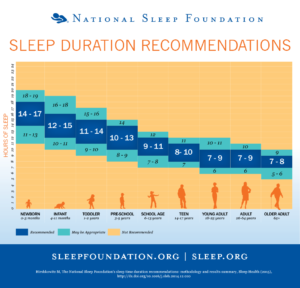 The U.S. National Sleep Foundation recommends that teens get between 8-10 hours of sleep a night. As they sleep, muscles are repaired, skin cells regenerate, immune systems are strengthened, hormones are released, and their bodies grow. Important things are taking place in their brains, too. Cerebral spinal fluid is pumped throughout the brain's ventricles, working like a vacuum cleaner, clearing away cell garbage and toxic proteins. At the same time, trillions of nerve cells are literally re-wiring themselves, working on the important role of memory storage. Humans have two different factors which trigger sleepiness: Circadian Rhythm and Sleep-Wake Balance. The circadian rhythm is our internal clock, regulated by the hypothalamus in the brain which sends signals to stay awake. In the evening, as the sun sets and there is less light, the hypothalamus starts to slow down and begins to release melatonin, a hormone that makes us feel sleepy. At the same time, the sleep-wake balance, also regulated by the hypothalamus, reminds the body that it needs to go to sleep after a certain time, and this feeling gets stronger every hour we are awake. But did you know there is a natural change that affects teens' sleep cues during adolescence? Teenagers have what is called a "sleep phase delay." Where they once may have felt sleepy around 8:00 or 9:00 pm before puberty, they may now start to only begin to feel sleepy around 10:00 or 11:00 pm. This can make it difficult for some teens to fall asleep early enough to still get the amount of sleep recommended, since they have to wake up so early for school. But teens can also complicate things by staying up very late doing homework, or sleeping in too long on the weekend, thus disrupting their circadian rhythm.
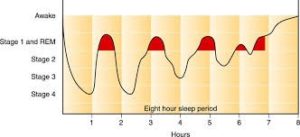 Sleep is divided into REM (rapid eye movement) also known as active or dreaming sleep, and 4 stages of deep (NonREM) sleep. Different memories are stored during these different stages. During the shorter REM sleep, memories of how to do something (e.g. playing an instrument, how to play a sport, etc.) - things that take a longer time to learn - are stored. During the 4 stages of deep sleep, facts learned during the day (e.g. math equations, capitals of cities, memories of important life events, like the first day of school) are preserved. If children and adolescents do not get adequate sleep, they will not have the opportunity to store and preserve the information they are learning each day. Many factors can create sleep difficulties for students such as: school work, extra-curricular activities, stress, sleep environment, a wrong view of sleep (thinking they don't need much),and use of electronic devices. Phones and laptops can disrupt sleep because the screens emit a blue wavelength light which has been shown to disrupt the circadian rhythm and suppress melatonin release. There are risks for not sleeping enough. Obesity, depression, poor academic performance, poor self-control, at risk for accidents, illnesses (disrupts immune system), and as mentioned above – not retaining the information they have learned) are some of examples. A few ways teens can improve sleep habits are:
The U.S. National Sleep Foundation recommends that teens get between 8-10 hours of sleep a night. As they sleep, muscles are repaired, skin cells regenerate, immune systems are strengthened, hormones are released, and their bodies grow. Important things are taking place in their brains, too. Cerebral spinal fluid is pumped throughout the brain's ventricles, working like a vacuum cleaner, clearing away cell garbage and toxic proteins. At the same time, trillions of nerve cells are literally re-wiring themselves, working on the important role of memory storage. Humans have two different factors which trigger sleepiness: Circadian Rhythm and Sleep-Wake Balance. The circadian rhythm is our internal clock, regulated by the hypothalamus in the brain which sends signals to stay awake. In the evening, as the sun sets and there is less light, the hypothalamus starts to slow down and begins to release melatonin, a hormone that makes us feel sleepy. At the same time, the sleep-wake balance, also regulated by the hypothalamus, reminds the body that it needs to go to sleep after a certain time, and this feeling gets stronger every hour we are awake. But did you know there is a natural change that affects teens' sleep cues during adolescence? Teenagers have what is called a "sleep phase delay." Where they once may have felt sleepy around 8:00 or 9:00 pm before puberty, they may now start to only begin to feel sleepy around 10:00 or 11:00 pm. This can make it difficult for some teens to fall asleep early enough to still get the amount of sleep recommended, since they have to wake up so early for school. But teens can also complicate things by staying up very late doing homework, or sleeping in too long on the weekend, thus disrupting their circadian rhythm. Sleep is divided into REM (rapid eye movement) also known as active or dreaming sleep, and 4 stages of deep (NonREM) sleep. Different memories are stored during these different stages. During the shorter REM sleep, memories of how to do something (e.g. playing an instrument, how to play a sport, etc.) - things that take a longer time to learn - are stored. During the 4 stages of deep sleep, facts learned during the day (e.g. math equations, capitals of cities, memories of important life events, like the first day of school) are preserved. If children and adolescents do not get adequate sleep, they will not have the opportunity to store and preserve the information they are learning each day. Many factors can create sleep difficulties for students such as: school work, extra-curricular activities, stress, sleep environment, a wrong view of sleep (thinking they don't need much),and use of electronic devices. Phones and laptops can disrupt sleep because the screens emit a blue wavelength light which has been shown to disrupt the circadian rhythm and suppress melatonin release. There are risks for not sleeping enough. Obesity, depression, poor academic performance, poor self-control, at risk for accidents, illnesses (disrupts immune system), and as mentioned above – not retaining the information they have learned) are some of examples. A few ways teens can improve sleep habits are: - Go to bed the same time each night,
- If you make up sleep for lost on the weekend, only sleep 2 hours more than your normal wake up time
- If you nap, don’t nap for over 60 minutes
- Avoid caffeine
- When using electronics at night, use dimming controls/ "night shift" setting on your phone for a warmer light
- Make sure your room is comfortable – quiet, dark, not too hot, not too cold
- Exercise 20-30 min per day- but not within 2-3 hours of sleep
- If you can't sleep, get up. Read or listen to music for 30 minutes, and then try again
- 每天晚上同一时间上床睡觉
- 如果你想在周末弥补平时的睡眠不足,比正常晚起2个小时就可以。
- 如果小憩休息,不要超过60分钟。
- 拒绝咖啡因
- 在夜间使用电子设备时,使用调光控制/“夜间模式"设置,以获得更温暖的光线。
- 每天运动20-30分钟---不要在睡前2-3小时内进行
- 如果你睡不着,可以起床读书或者听音乐,30分钟后再次尝试入睡。
